By Antti Salo.
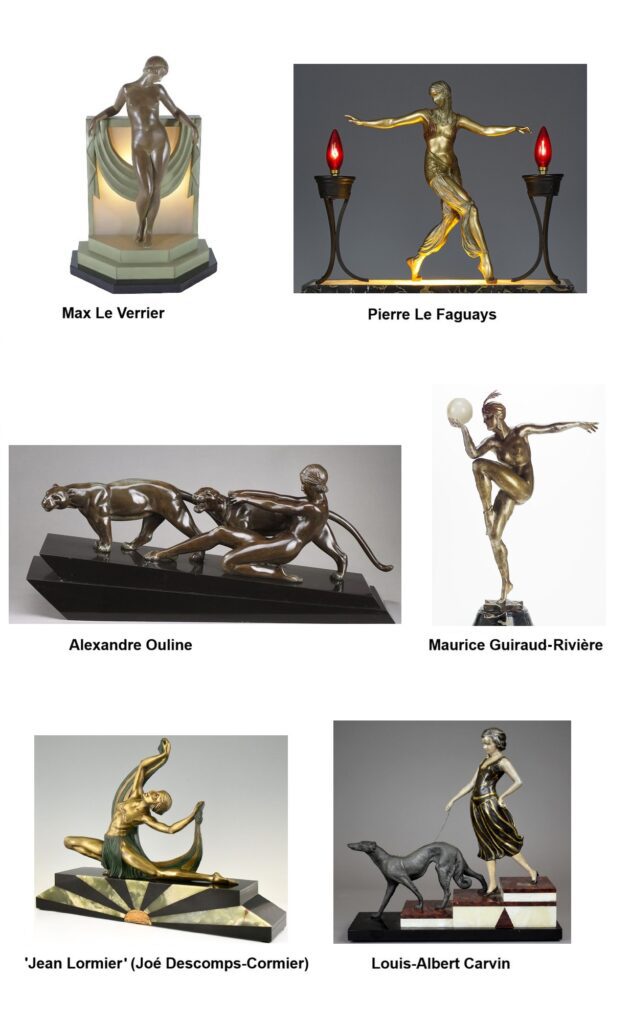
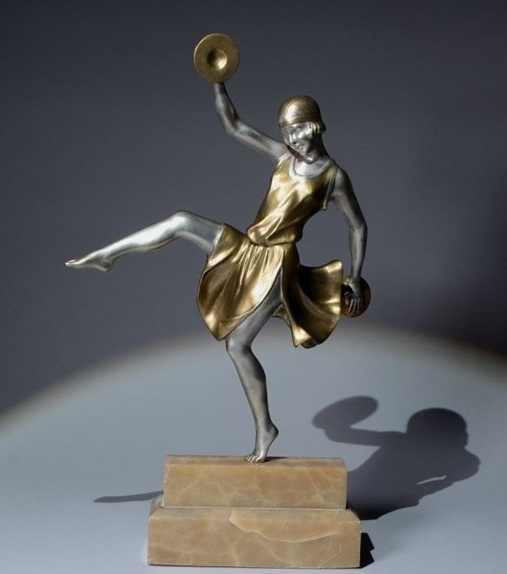
Figurines and statuettes are a unique and distinctive part of the Art Deco world. They are often divided into two groups depending on whether they were originally art or commercial products. In this article, Antti Salo will focus on some of the latter ones. The most common and best-known subject in that group is the posing and dancing young woman, playful and fearless. Yet these statues are also an oddity of the genre.
Influences from the 19th century
The history of figurines is long, the oldest ones we know were carved 35,000 – 40,000 years ago. Throughout history they have been made for religious purposes or for honoring notable figures, representing ideas and ideals, as toys for children, or just for being decorative.
During the 19th century the art of sculpture saw some significant changes. Like paintings, the sculptures started to depict human character and feelings in a new way. At the same time, decorative miniature figurines became more and more popular as household items.
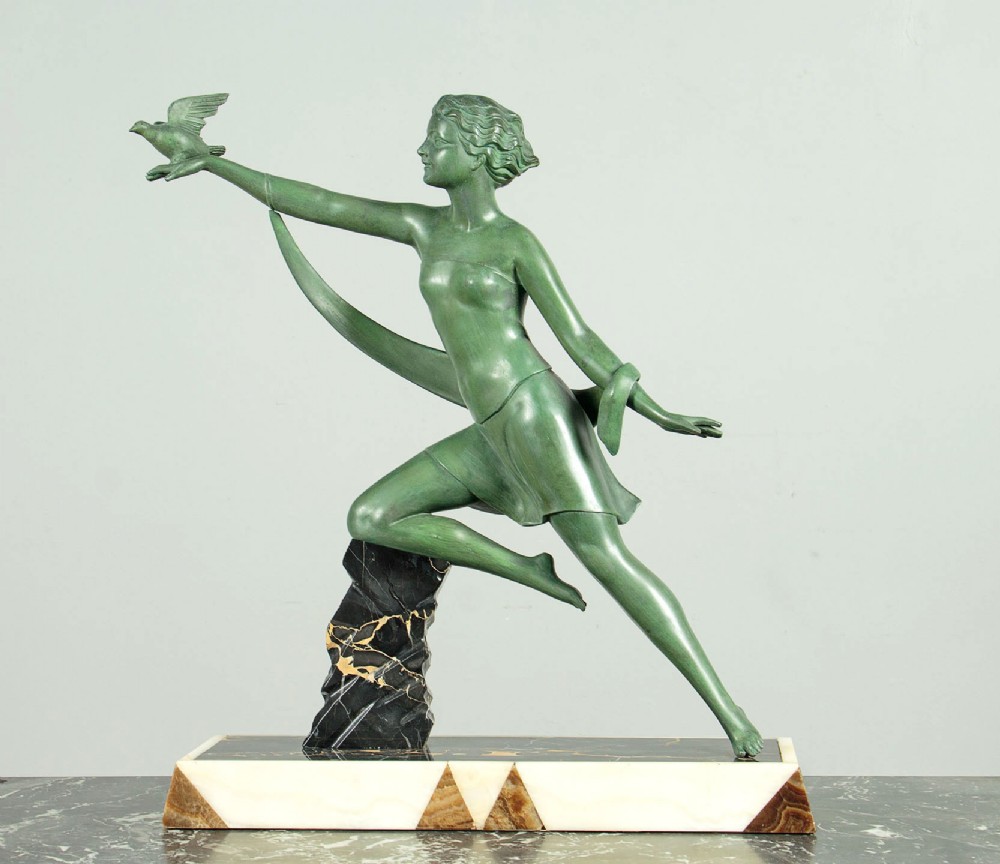
One of the features of 19th century sculpture was the depiction of movement and liveliness. This is crucial to many decorative Art Deco statues, the dancing girls as well as to the ones depicting athletes, skaters and other sports people, which were made especially in Germany. Dancers and other young women were mainly French productions. The production of more traditional miniature statues also continued; Diana figures, exotic warriors, etc. The volume of statue production altogether is also evidenced by the fact that there were several foundries in Paris alone manufacturing them, such as LNJL (Les Neveux de Jules Lehman) and Edmond Etling & Cie.
Variety of Sculpture
Animal sculptures were also very popular in the 19th century. The Art Deco sculptors such as Rulas, Georges Lavroff (Georgij Lavrov) and G.H. Laurent regenerated the art form with their streamlined and expressive birds, felines and other, often exotic, animal figures.
Those works are in many ways reminiscent of the most highly regarded, groundbreaking sculpture of the 1920s and 30s, by artists such as Csaky, Miklos, Aaltonen, Hagenauer, Martel and many others. Some of them are still considered representatives of Art Deco, and some combined Art Deco with Cubism, Constructivism, Classicism, amongst others. Some clearly Art Deco works are in between art and decoration, like the iconic Faun and Nymph by Pierre le Faguays.
These Art Deco sculptures also had practical functions, such as lamp holders, or they were seen as pilasters or car hood ornaments; or were used for decorative features on other objects, particularly in architecture.
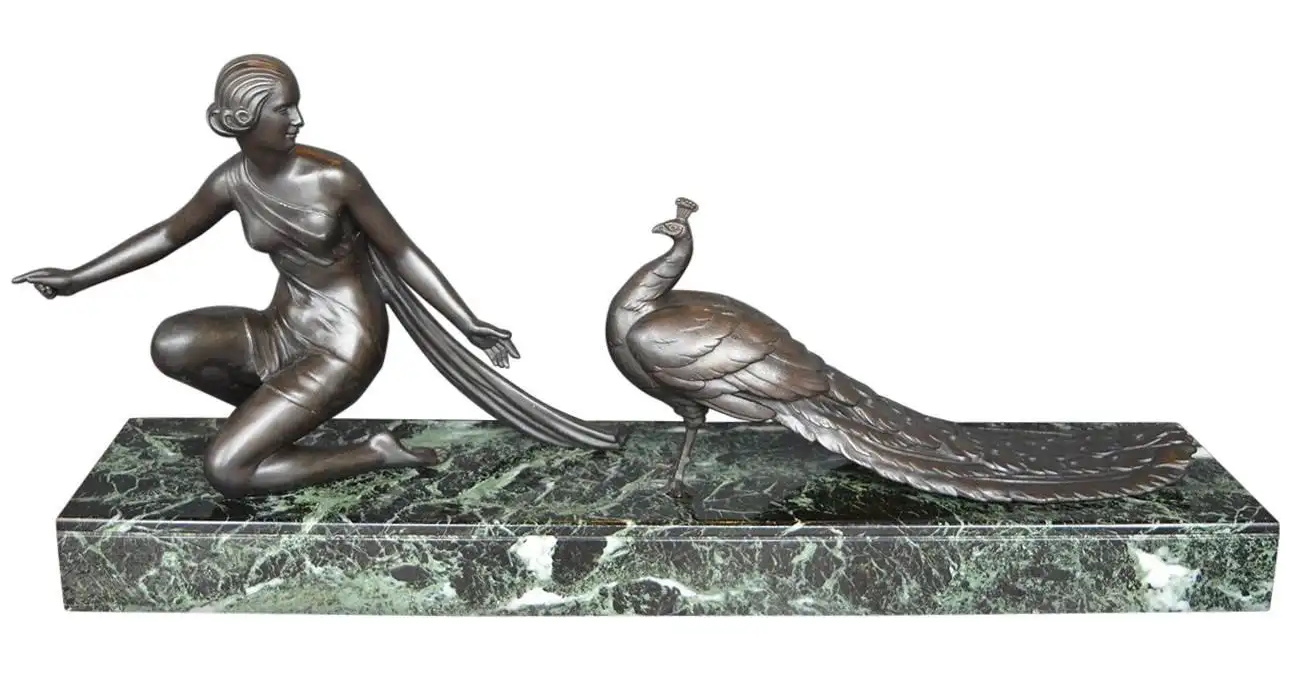
Alexandre Ouline Sculpture of a Woman with a Peacock
(1st Dibs)
And Art Deco Created Woman
Why was the young woman such an attractive subject for decorative Art Deco sculptors? There may be several reasons for that.
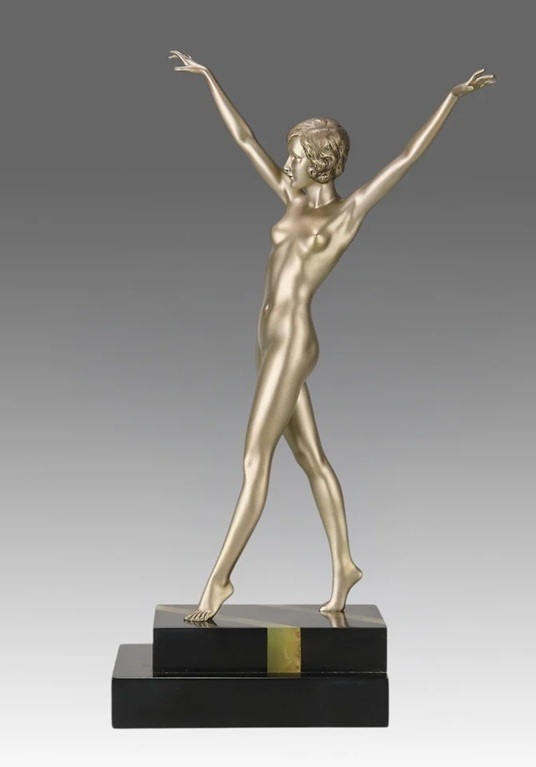
The nude or scantily clad human body has always been of interest to art, but new moral concepts of the early 20th century allowed young women to be depicted in art as joyful, individual, capable to express themselves freely. However, these statuettes they don’t usually appear as erotic, at least not to a viewer of our time.
In the early 20th century the human body itself began to receive new kind of appreciation. The Olympic ideals were born again, and sports, athletics and gymnastics in general became popular. Exercise and health played also an important part in political or labour movements and groups, although in some countries this was reversed and it was a disguise for prohibited political activities.
(1930.fr/)
In the 1920s, naturism gained popularity around Europe. Following the example of ancient Greece, there was a desire to associate nudity with higher spititual values. In Germany, the Körperkultur and the Hellerau Academy wanted to present a healthy and non-erotic approach to the human body, and the movement was warmly received in many countries. Health and youth enjoyed great cultural esteem.
And at the same time there was love for city life, cars, aeroplanes and machinery, as well as admiration of smoky jazz joints and neon lights. It is difficult to judge whether the 1920s and 30s in continental Europe was the heyday of brothels and openly erotic cabarets, but it certainly wasn’t a quiet period for them either.
Decorative Thoughts?
When these statuettes were created, there must have been a lot of positive thinking in the air. Early democracy and universal suffrage raised optimism, so did economic growth, the weakening of old power structures, social reforms, even new kinds of popular music. The women’s liberation movement had a strong influence on both values and fashion, finally creating the new independent young lady – reaching the penultimate form in the flapper.
Thus it seems that statues of dancing girls have symbolism in them and they may include a statement. As the ideals of discipline and productivity of the modern technology were opposed by individualism and liberty, most of these objects seem to celebrate the latter.
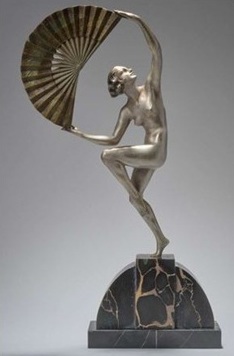
There were other subjects, not just dancers. Young women walking dogs, playing with a ball or hula hoop, posing with a fan in hand or showing off a flowing skirt or a magnificent cape, female harlequins or musicians. But the most famous works depict dancers. Some statues in the same style were also made of film stars of the era.
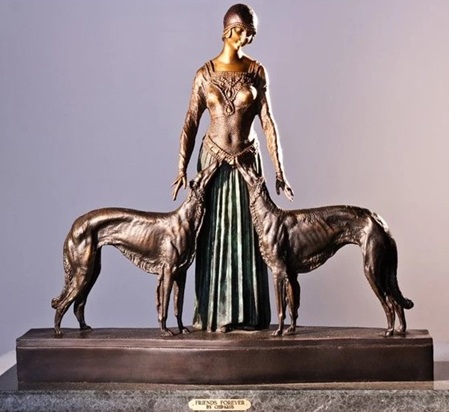
But the style – what is it about these girls that makes us place them in the Art Deco era as soon as we see them? Actually only the pedestals, the bases under the figurines, are clearly Art Deco. They are an important part of the whole and the impression a statue creates. They were made of marble, onyx or other comely stone and most often with an Art Deco form and detailing.
But the figurines themselves are not carved in the style of Art Deco. On the contrary, they seem very realistic, like in classical sculpture, and in many cases their outfits are more reminiscent of Art Nouveau than Art Deco.
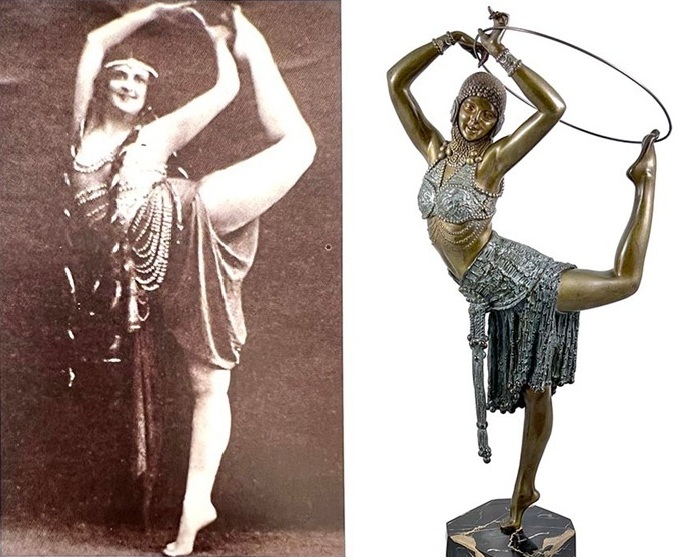
However, the realistically sculpted female figures represent an ideal of the era: they are usually slender and long-limbed with flapper bob haircuts. And they are clearly stylized when we compare them to photographs of real dancers at the time.
Somehow these figurines manage to convey the same atmosphere as the films of that time. Some might say that they manage to strike a balance between sophisticated, carefree and amusing.
Demétre Chiparus
It would be difficult to pinpoint the moment or to name the first sculptors who moved from classical or Art Noveau styles to Art Deco, perhaps the honour goes to Franz Iffland or Ferdinand Preiss. During the two decades there were several outstanding artists. Many of the those who are known today worked in Paris.
Nowadays, the most famous sculptor of the time may be Demétre Chiparus (born 1886), a Romanian artist who in 1912 he moved to Paris to study at the École des Beaux-Arts. His most characteristic works were made between 1920-33. He was instrumental in making dancing girls the most prominent type of sculpture in the Art Deco style, and praised already in the 1920’s for his unique expressiveness and refined and meticulous finishing.
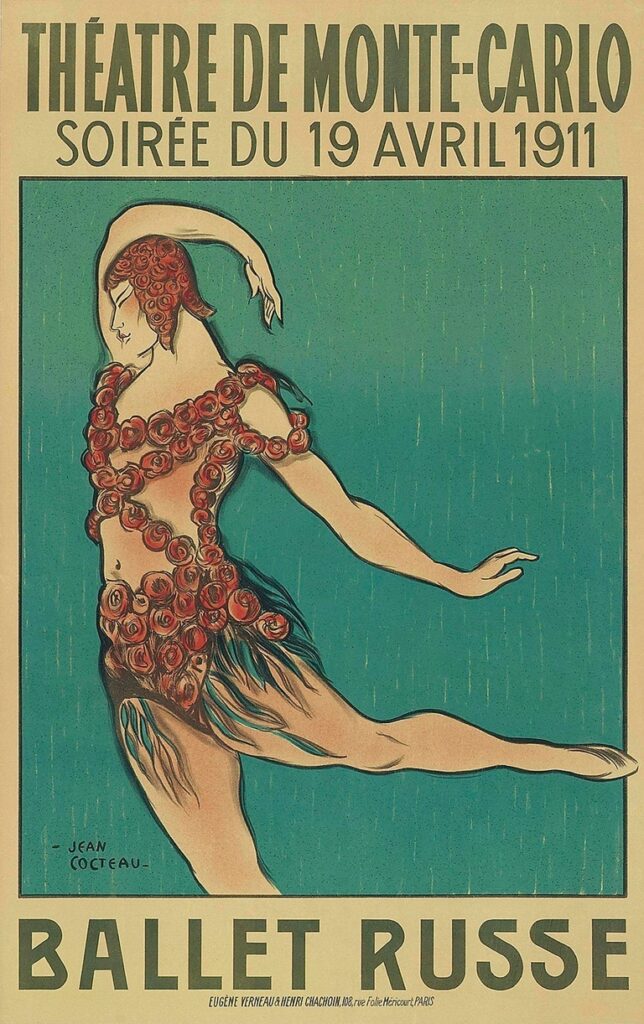
Like many artists of the era, Chiparus was influenced by ancient Egyptian art and early motion pictures, but especially by the Paris-based Ballets Russes, the Casino de Paris, and the Folies Bergére theatre. The sets and music of these theatres were designed by great talents from Igor Stravinsky to Pablo Picasso and Ivan Bilibin. It could easily be argued that since the Ballets Russes started in Paris as early as 1909, Chiparus may have taken inspiration and ideas from them long before the actual Art Deco era.
For Chiparus, the main source of inspiration were the costumes of theatre performances by famous designers, like Erté and Natalia Goncharova, who also had a great influence on fashion at the time. This is where Chiparus got the ideas for the strikingly unique clothes for the girls in his works. In fact, he sometimes directly copied the clothing. For example, his famous ‘Starfish Girl’ reproduces the dress of the Goldfish in Lev Annensky’s ballet ’Underwater Kingdom’.
Materials
One of the big questions in the production of goods in the 1920s was whether all products should be suitable for mass production. The decorative Art Deco statuettes seldom were unique. They were manufactured for sale in large quantities, produced in many sizes, and in order to meet a wider market, in many prices too, depending on the material. The most popular metal was bronze, sometimes plated with silver or gold.
There is also a dark side to Art Deco sculpture: the consumption of ivory. From the Ancient Greek period the term chryselephantine referred to ivory objects finished with gold. But by the late 19th century, the Belgian Empire under King Leopold II was keen to find an even larger market for ivory, which came from the Congo. Producers broadened the meaning that any object made of ivory and metal (and even wood) could be described as chryselephantine. It was not only piano keys and billiard balls but many kinds of jewellery, ornaments and decorative and functional items were soon made from ivory. Unfortunately, also Art Deco sculptors fell in love with this material.
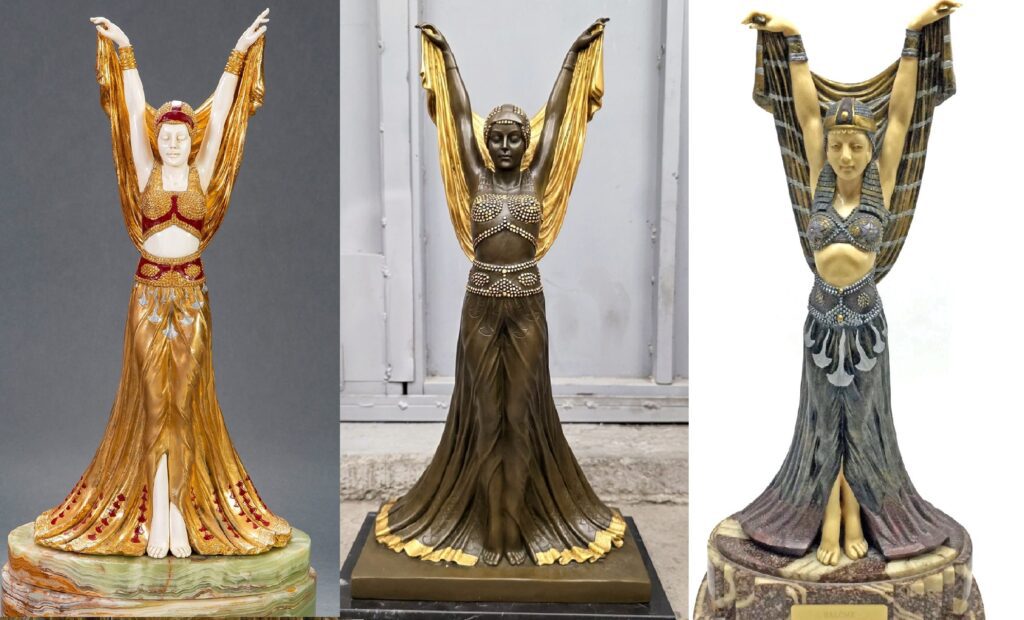
Active sales promotion of ivory led to an immense massacre of elephants in the Congo. Eventually, there was so much ivory on the market that its price per kilogram was lower than that of bronze. It is ironic that by the Art Deco period, much of this ivory could have been replaced with new, synthetic materials. It would be interesting to know how much these materials were used: as sculptors and manufacturers could have chosen from celluloid (which had also other early trade names, e.g. Parkesine and Xylonite), glalith (made from milk), bakelite or other early plastics, like catalin and faturan.
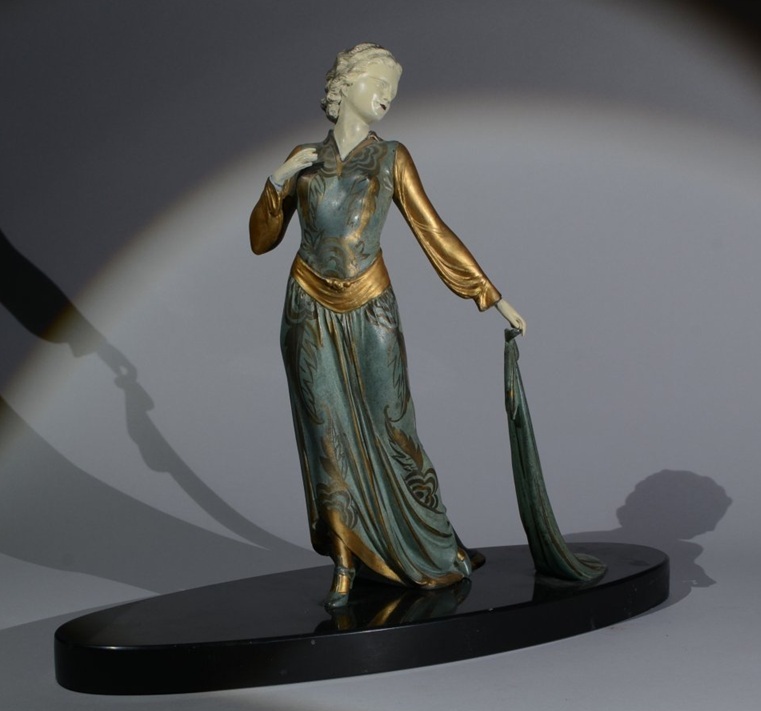
Ivory and its imitations were used mainly when the sculptures were cast in bronze. Cheaper statuettes could be made from materials such as terracotta, calamine (zinc), pewter and plaster. These were usually the exact copies of exclusive originals but sold at lower prices in less expensive stores and galleries.
Collecting Art Deco Statuettes
After the Art Deco period interest in these objects waned, but it began to revive in the 1970s. They are still collected and widely available at online auctions and antique shops. Although many of these items come from the Continent there is an active market in the UK.
Prices vary a lot, depending on condition, signatures, foundry marks and other usual considerations. Some are the artist’s own work, some are studio works, some are later copies. Sizes range from 30 cm to a colossal metre and a half!
Just as responsible and law-abiding traders do not sell ivory, responsible collectors only look for statues that do not contain ivory. Besides, if a modern collector is seeking statues made from the most expensive materials of the time, then their choice should be bronze over ivory anyway! At the opposite end of the scale, the cheaper, more mass-produced plaster statuettes can also be very desirable if they have remained in mint condition – a rare thing.
In the late 1990s, a great interest in the oversized Art Deco statues arose among Russian collectors, as wealthy Russians sought to reconnect with their artistic heritage, notably the Ballets Russes and their wider cultural impact. Huge prices were paid for the biggest original statues. Today, the largest collection of statues in the world is said to be held at the Moscow Art Deco Museum.
Nowadays, resin Art Deco style statuettes are being manufactured. These modern versions can be just as beautiful as the older ones, however, they should not be sold at same the price as the old and elaborate ones, so buyers, beware!

https://1930.fr/artdeco/collection/sculptures/?orderby=date
If you would like to learn more about these statuettes, Antti recommends the following reading:
Victor Arwas, Art Deco Sculpture: Chryselephantine Statues of the Twenties and Thirties
Bryan Catley, Art Deco and Other Figures
Alastair Duncan, Art Deco Sculpture
Janice Kehoe, https://solo-antiques.co.uk/a-brief-history-of-art-deco-sculpture/
Alberto Shayo, Chiparus: Master of Art Deco
Sheila Gibson Stoodley, https://www.artandantiquesmag.com/art-deco-sculptures/